
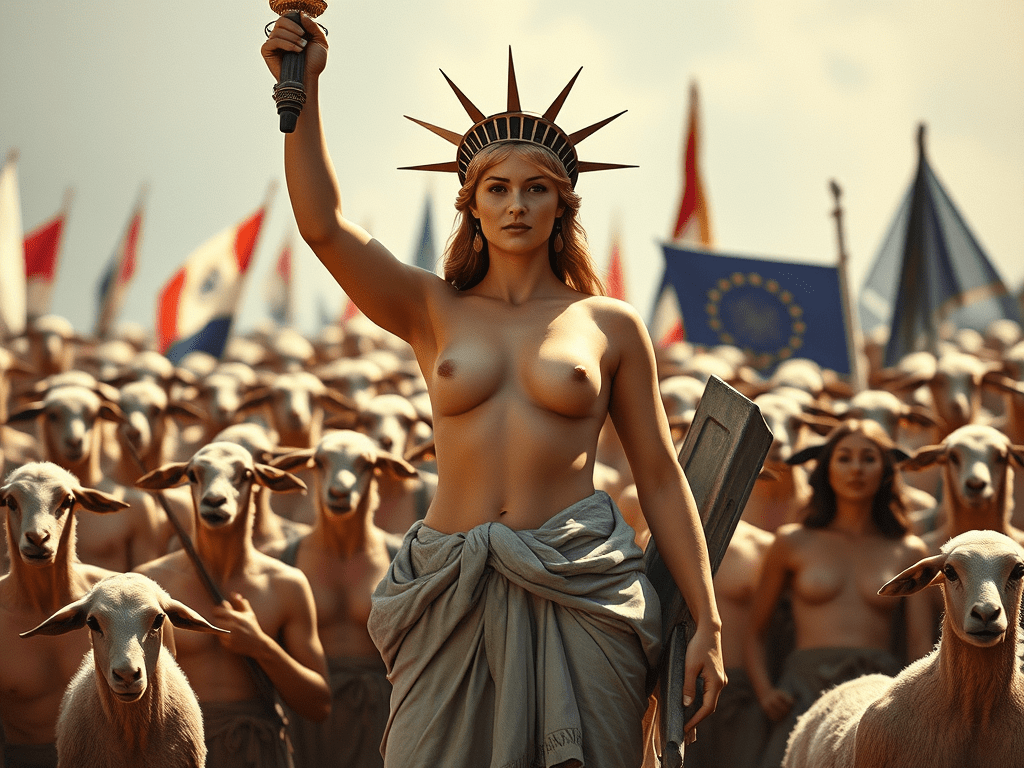
Liberty Has Always Been An Exposed Woman
On the Detriments of Asking for Enough

“Liberty Leading the People” is a painting influenced by the French Revolution, painted in 1830, and has since been a symbol for all revolutionary movements. In this painting, Liberty is a bare-chested woman, quite similar to the 21st-century activists of the #Femen movement. Why is it that about 200 years before even the idea of Femen was born, Liberty was painted as a woman, and not any woman but a semi-nude woman? What is it in womanhood and being exposed?
It is the mere “Radicalness” of it that makes it liberating. Women have always been suppressed, in most if not all cultures, and they have never been the leader. They have been considered devoid of ideas, courage or sound judgement, all qualities necessary for leading. Women have always been the safety valve for imposing the social norms and keeping the “status quo”. They have been controlled through the body politics of gender, to reinforce conformity.
An act is only revolutionary if it is “radical”. When an act or a movement tries to keep the “Social Norm” and make just some necessary adjustments, for a better situation, the act unintentionally ends up reiterating the standards of the status quo (without knowing it). The result of course will be no actual change, but a reassemblage and a reordering of the social features which created the need for change in the first place. That is why the majority of social movements never actually made any tangible change. Suffrage movements changed the appearance of the place of women in society, but they neither changed patriarchy, nor the hierarchical inferiority of women, and not even the commonplace misogyny. Just like all the acts towards #truthandreconciliation in Canada are mostly performative slogans and empty shows and still, there is little to no change in Indigenous lives.
“The more radical the person is, the more fully he or she enters into reality so that, knowing it better, he or she can transform it. This individual is not afraid to confront, to listen, to see the world unveiled. This person is not afraid to meet the people or to enter into a dialogue with them. This person does not consider himself or herself the proprietor of history or of all people, or the liberator of the oppressed; but he or she does commit himself or herself, within history, to fight at their side.” (Paulo Freire)
The problem is, usually radical acts are usually seen as ineffective because they can create defensive reactions. However, these very defensive reactions, as many cultural theorists believe, produce a fissure in society that can break down the social constructions of the “status quo”. On the contrary, avoiding radical acts for having the support of the majority, will be aiming for “good enough” and creating an environment of “conformity”. Therefore, asking for enough, and aiming for minimum change (sometimes with the hope of future changes, which for the reasons mentioned will never happen) is never beneficial for society. It is either a creation of more of the same (as in all feminist and anti-racism movements of the past two centuries) or even becomes the birthplace of a bigger evil (the case at hand for me is the 1979 Islamic Revolution in Iran).
Now that I have come to an example from my home country, Iran, I shall add one final point. As we approach the first anniversary of the murder of #mahsaamini (whose original Kurdish name was “Jina”, itself another case of oppression targetting ethnic minorities), we can look back at a movement that is still creeping under the surface layers of streets of Iran. This was, by the word of many political analysts and not me, probably the first revolutionary movement in history that was started and led by women. It was also unique in some other senses like not having a single leader and having many beautiful objectives like human rights, and environmental issues, amongst others. This is in fact like that famous painting, an aesthetic picture of a woman leader, who aims for the liberty of not just herself and her choice of clothing, but a revolt for the betterment of the whole society. The beautiful movement in Iran, as well as any other revolutionary movement, can only create real change if it creates that fissure, that crack, inside the society itself, if it does not want to reinforce the status quo of patriarchy (women’s rights issues) and cultural hegemony (ethnic rights issues). Otherwise, just like the French revolution that ended in the tyranny of Robespierre, it will lead the Iranian people inside another hegemonic system with apparently different (reordered), but fundamentally the same features.
Let us celebrate the anniversary of this beautiful movement, and push towards its goals more than ever, with #radical actions. Do not condemn people who are not satisfied with “good enough”, commend them, and praise their bravery and their commitment to be on the right side of history, more often than not, at the price of their own reputation.
 Chez Sohrab!