
Christmas, Winter Solstice, and Yaldā Night
Have you ever heard this idea that, based on both biblical and historical evidence, Jesus was most probably born in July or August?
Are you familiar with the astronomical concept of Winter Solstice?
Do you know anything about the Iranic custom of “Yaldā” and its relationship to many ancient Indo-European beliefs?
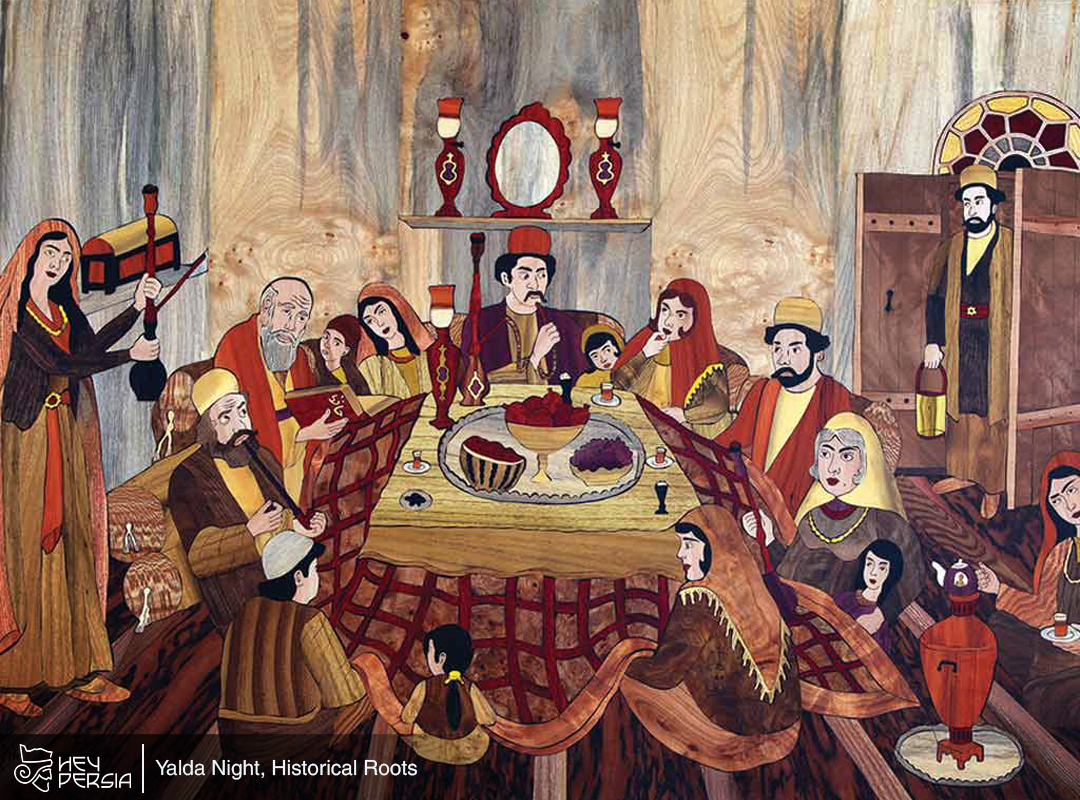
I am going to briefly answer these questions here, and introduce the Iranic festival of Yalda Night (or Shab-e Cheleh شب چله) and its corresponding cultures:
The Four Astronomical Events:
Iranic culture has an unbelievably close kinship with nature, and many of the beliefs and rituals since two millennia B.C.E to the date have been in exact harmony with the events in the natural world. In this multitude of natural phenomena, four Astronomical events stand out. They have been the basis of Iranic Calendar since at least 1000 B.C.E. They are still observed as four of the most important ceremonies by people of Iranic culture all over the world. And they proved to be accurately calculated to the second when compared to the scientifically calculated numbers. These four events are the two equinoxes and solstices.
The Two Equinox and Iranic Beliefs:
The Two Equinoxes have been the symbol of natural harmony in Iranic culture. They represent an inherent quality of the universe. This quality is Equal Balance as the True Order of things and manifests itself in these two celestial events. It is embodied in the equality of darkness and brightness. Vernal Equinox (March or Spring Equinox), scientifically marks the beginning of Spring. The revival of nature marks the start of the cyclical movement of time. Therefore, it is the Iranic New Year or Norouz in the Iranic Calendar. It is observed by Iranic people in Afghanistan, Albania, Azerbaijan, Iran, India, Kurdistan, Uzbekistan, and Tajikistan, amongst other countries. The Autumnal Equinox (September of Fall Equinox), marks the beginning of autumn. It was demise of nature and the time of autumnal harvest celebrated by a dance festival. Both equinoxes were celebrations of the god “Varuna.” Varuna was the god of skies and the keeper of balance in the universe. Zoroastrianism later turned “Varuna” into “Mazda” (literally meaning “The Great Knowledge-bearer”). Subsequently, the fall equinox later turned into the “Mehregan” celebration, while Norouz became associated with “Mazda”.
Summer Solstice and Midsommer:
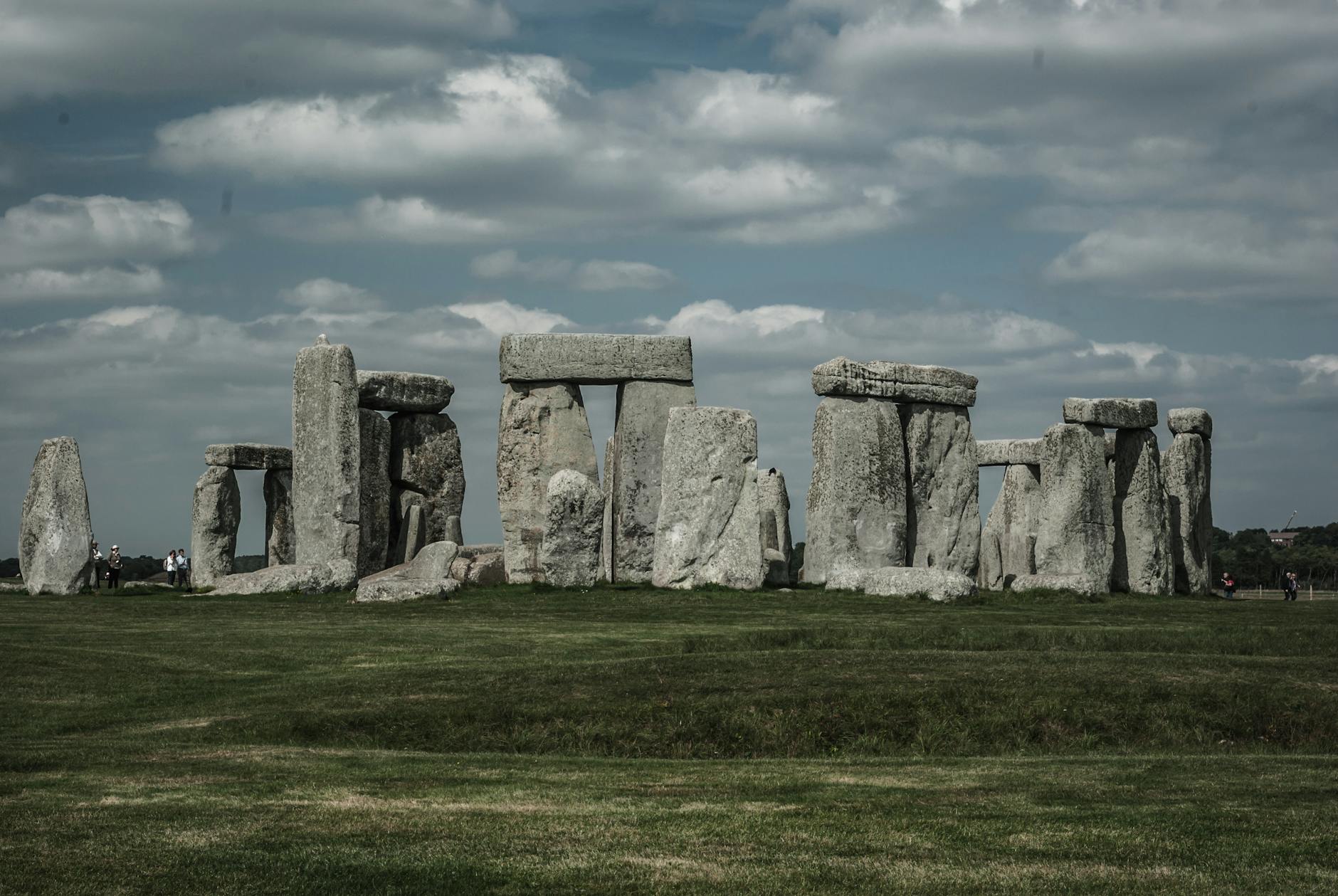
Many might have heard about the Germanic celebration of Midsommer, still being observed in Northern Europe and Scandinavia. Many other cultures celebrate the Summer Solstice. On this day, days start to get shorter. Iranic people also celebrated it – originally – as the day when the god of moon and darkness (Mangha) is born. Later, again in the changes that Zoroastrianism brought to the culture, it turned into the “Tiregan” celebration. In general, this date is more prominent for Indo-European cultures, like Germanic people, Indo-Iranians, or Celts. Stonehenge, in almost every scientific speculation, is considered to be a form of celestial calculator of the two Solstices. But other cultures also celebrate this natural event. Incas celebrated “Wiñoy Tripantu” on this day which was the beginning of their New Year.
Winter Solstice and Yule:
Germanic people, also have the famous Yule celebration on Winter Solstice. This was celebrated as a big feast, which was later adopted by the Roman Empire. On Winter Solstice, unlike its summer counterpart, days start to get longer. This celestial moment forms the basis of another festival amongst Slavic people known as Koliada. It used to mark the beginning of their year. Once again, the Roman Empire appropriated the word as the name of the first day of their year. The English word “Calendar” is derived from this root! For Iranic people, it was the birth of the god of Sun and brightness: Mithra. They used to celebrate it all through the night, giving homage to Mithra. This later gave birth to the religion of “Mithraism” from one side, and the practice of “Yalda” from the other.
Paganism, Christianity, and Yaldā:
Mithraism left Iranic territories very soon and found followers in the West, while Zoroastrianism was replacing it at home. Zoroastrianism (through its short-lived predecessor “Zurvanism”) introduced Mazda. Mazda had the roles of Mithra and some of Varuna’s together. The new beliefs gave some other qualities of Varuna and all of Mangha to the evil deity “Reymana” (or later “Ahermana”). Finally it gave the remainder of Varuna’s roles first to “Zurvan” (the god of time and existence) and later to a minor deity “Verethragna”.
Mithraism and Its Roman Adaptation:
At the same time, Mithraism somehow became the prevalent religion in the Roman Empire. It was both adopted and appropriated (similar to Midsommer, Yule, and Kuliada). Even the names of the weekdays (as we see in English as well as Latin languages) are adoptions and appropriations. The day of the Moon (Mangha), Sun (Mithra), and the Sky (Varuna, early Iranic, Verethragna, Zoroastrian, and Tiwra, Germanic) followed the Mithraist beliefs. Monday (Moon’s Day), Sunday (Sun’s Day) and Tuesday (Tiwra’s Day) are still in use. As a result, many of the original Mithra-related beliefs were adopted into the culture of Romans and expanded across Europe. One obvious example is having the day of the sun (Sunday) as the day of worship. Another, was the importance of winter solstice and seeing it as a “Holy Night”. It now had a new name: “Dies Natalis Solis Invicti” or “The Birthday of Invincible Sun”.
Constantine, Council of Nicaea, and Gregory XIII:
When Emperor Constantine declared Christianity to be the official religion of the Roman Empire, many did not welcome it. There was a dire need for some kind of compromise. They needed to attract peasants who were not inclined to leave the gods of their fathers. They also had to satisfy many powerful people who had already converted to Christianity. The result was the Council of Nicaea. A big group of Christian leaders from different sects gathered consulting political advisors, Senators, and tribal elders. Many pagan beliefs entered their way into Christianity in those debates and spread like wildfire across the globe after that. Without a doubt, Mithraism was one of the most influential of these beliefs. One of the very obvious Mithraic beliefs was the trinity: Mithra, Luna, and (by the time of Roman appropriation) Jupitra. Jupiter (literally: Sky Father) gave his role to “The Father”, Mithra (the most esteemed deity) to “The Son”, and “The Holy Spirit” was invented to replace Luna. Another important Mitraic adoption was “Dies Natalis Solis Invicti” which suddenly became “The Birthday of the Savior Son”!!! Jesus’s birth date was moved from July to December 21st, the Winter Solstice. But why, if it is the 21st, today we celebrate it on the 25th? The answer is the Roman Catholic calendar. It did not have any mechanism for correcting its annual errors. Over the years, Christmas and other religious holidays moved up to a month. Finally, a more accurate calendar ordained by Pope Gregory XIII solved the errors. We still call it the Gregorian calendar. They tried to calculate the existing errors and revert them. However, in the end, a four-day error remained unaccounted for. Thus, “The Birthday of Invincible Suon” ended up on December 25th.
Iranic People and Significance of Yalda:

Iranic people, are a group much bigger than just Persians or people with Iranian nationality. A cultural group who have close historical connections for more than four millennia; they live from the banks of the Tigris River to the Indus River, and from the shores of Oman Gulf to the Aral Sea. They are descendants of early Indo-Iranians (a Branch of Indo-European people) and mixed with Eastern Semites and Southern Turkic peoples. Almost every ethnic group under the umbrella term of “Iranic people” observes Yalda to the date. This includes Persians, Kurds, Lurs, Baluchis, Afghans, Tajiks, Hazaras, Azeris, Mesopotamian Arabs, Armenians, Georgians, Turkmens, Uzbeks, Kashmiris, amongst many others. Yalda is extremely significant for Iranic people. The old belief in the prominence of Light as the ultimate Good is still in the collective subconscious of the people. Therefore, the birthday of the Sun is particularly important. It might be the most prominent Iranic ceremony after Norouz (the New Year). The latter, usually March 21st on the Gregorian Calendar; the former, December 21st. As mentioned, however, Iranic Calendar is different, and therefore it provides different dates. It is the official calendar of Iran and Afghanistan and is recognised by many other countries like India, Tajikistan, Iraq, and Azerbaijan. Yalda is the last day of the ninth month on the Iranic Calendar. It precisely marks the end of autumn and the beginning of winter, which is the longest night of the year. As the night is correlated with the return of charity and prosperity, the red colour (representing warmth and light) and the pomegranate fruit (representing abundance and fertility) are central to its symbology.
Costumes, Rituals, and Celebration of Yalda:
The word Yalda itself is from Syriac roots, meaning “Birth” (referring to the birth of Sun-god Mithra or the Light). In some areas like Kashmir, Tajikistan, and the North of Afghanistan, it is called “Cheleh” (Fortieth). In ancient times, they used to divide the winter into three forty-day periods. Yalda marks the end of the first period (Minor Cheleh) and the beginning of the two upcoming colder periods (Major Cheleh). It is speculated that ancient Iranic people might have called the night “Mehrizad”, meaning Mithra’s Birth. There is nothing more than speculation about how the night was celebrated, but holding a vigil, gathering around a fire, eating pomegranate while telling stories, and drinking wine are amongst the common speculations. Yalda is observed by Zoroastrians, but it has lost its importance in relation to nearby celebrations like “Azargan”, although it is still a holiday.
Modern rituals of Yalda are different for each region, but holding a vigil, gathering and reciting poetry, and setting a Yalda table are traceable in most of them. A Yalda table itself can have different elements. Yet, pomegranate fruit, Red Wine (or another red drink in more strictly Muslim households), Watermelon, and Mirrors and Candles can usually be seen. While Persians tend to recite poetry of Hafez on this night or even exercise the practice of Fal-e Hafez, Lur and Bakhtiari peoples prefer Shahnameh. Persians also put assorted nuts on their Yalda table, while Azeri people put dried figs and stews. Kurds of western Iran and eastern Iraq have dances and fireworks on this night, while Kurds of eastern Iran and Herati people of Afghanistan use this night to give presents to newlyweds and engaged couples. And through many other costumes and rituals, this night stands as a testament to the enduring cultural heritage of Iranic people, embodying resilience, hope, and unity. Something that the modern world is trying to rob them of on a daily basis …
 Chez Sohrab!
1 Comment