
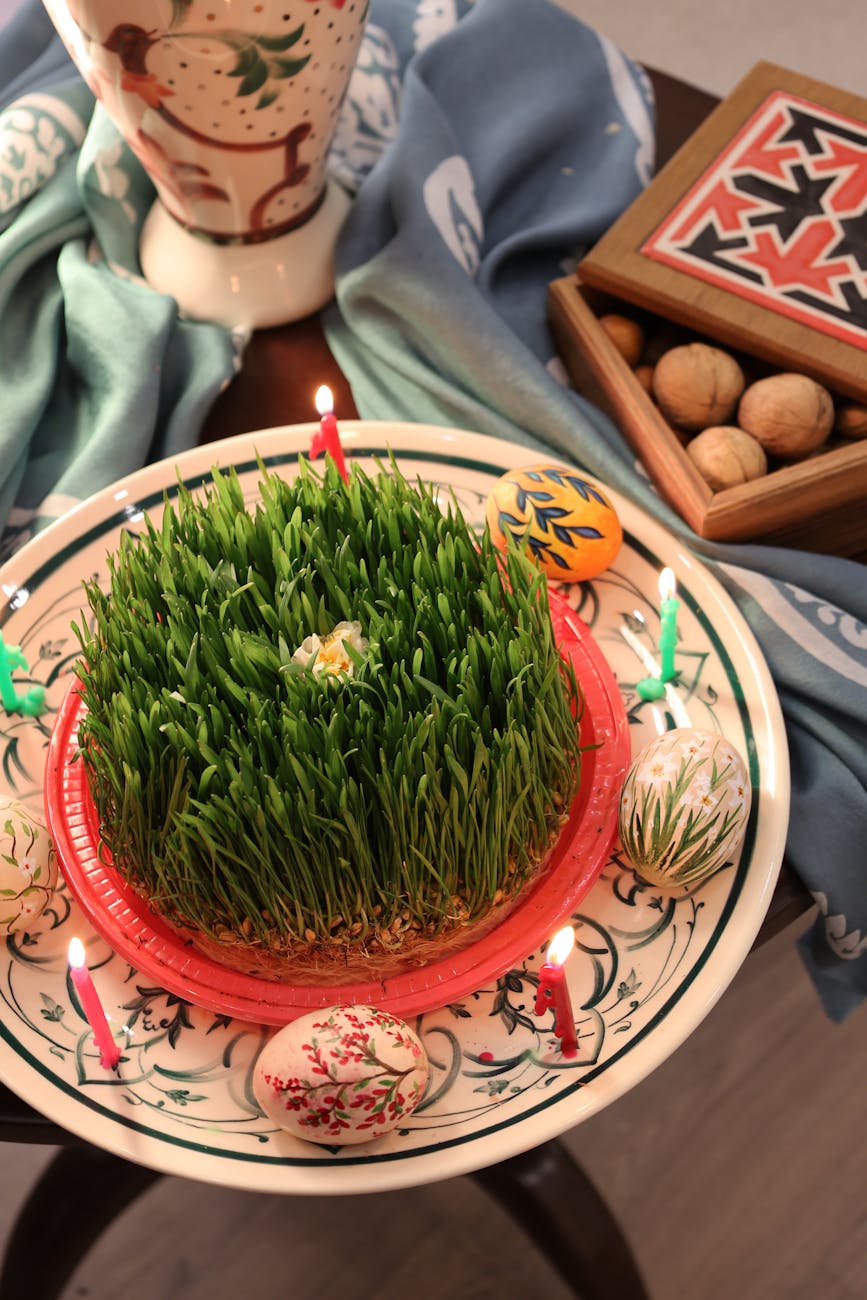
Correcting a Common Misinformation About “Haft Sīn” Table
The Earth will be positioned exactly at a certain point relative to the Sun in less than seven hours from the time I am writing this post. Scientists call this point “The March Equinox”, but my heritage culture calls it “Norūz” (I explained the importance of astronomical events in my post about “Yaldā”). This point marks the beginning of Spring, and for Iranic people, the beginning of their ancestral calendar.
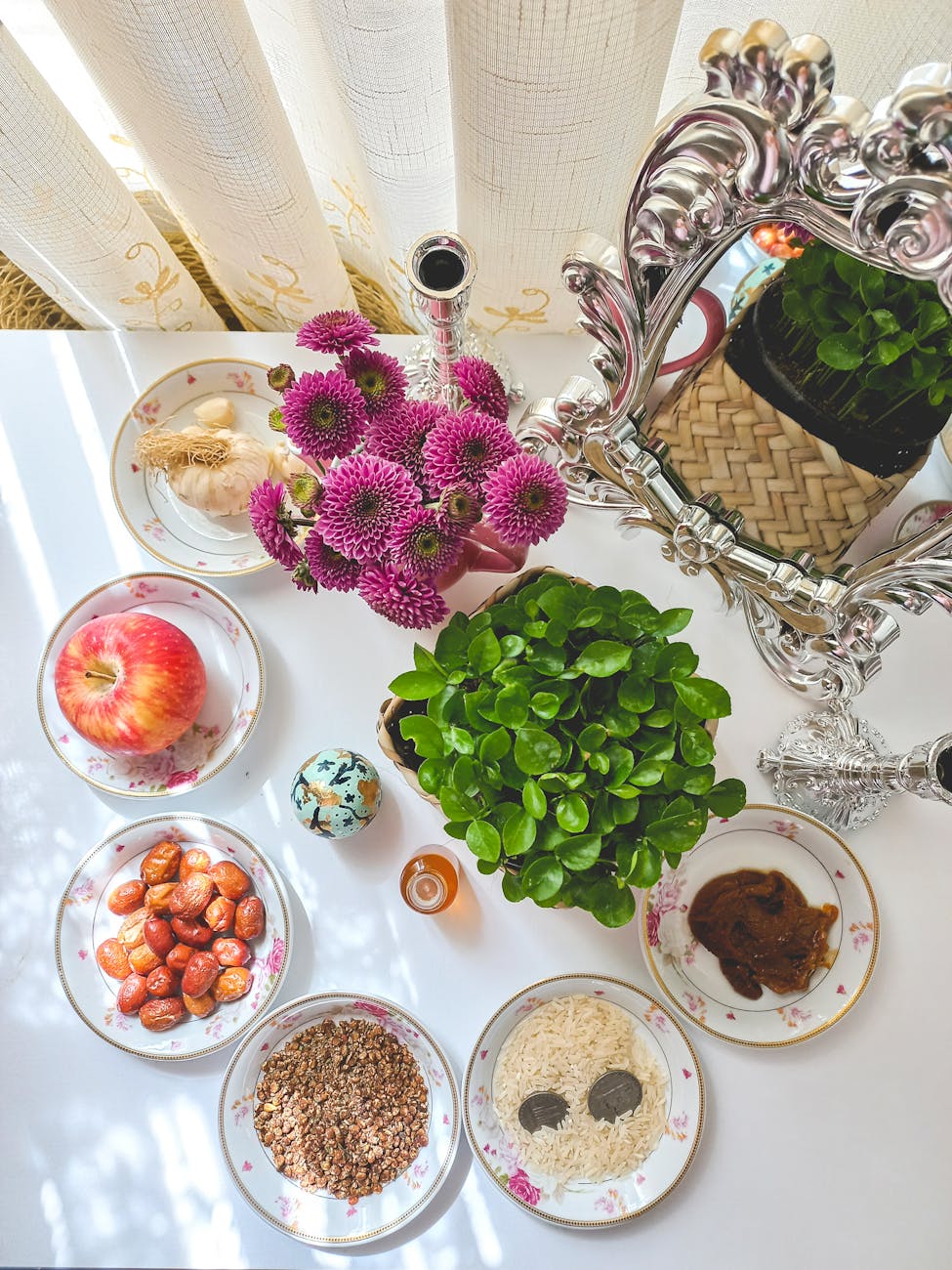
Norūz is usually associated with the “Haft Sīn” Table (Photo Above), although this costume is mostly limited to Iran and Northern/Eastern Afghanistan. In fact, more than half of the people who observe the tradition of Norūz do not recognise “Haft Sīn” as a part of it. This fact aside, what is usually said or written about the “Haft Sīn” Table has basic flaws and terrible misinformation. I don’t want to get into long and boring details. Let’s briefly get to the bottom of it! The most common explanation you find about “Haft Sīn” is that it consists of seven items (“Haft” meaning “Seven”). These items start with the letter “Sīn”, which is the equivalent of “S” in the Perso-Arabic alphabet. You might even see “coins” or “clock” as suitable items since their Persian equivalent starts with the /s/ sound. However, both words in the name of this costume are problematic! So, what is the real “Haft Sīn” you might ask?
The authentic form of this tradition goes back at least 1800 years, to the late years of the Parthian Empire. It does not have seven items, but nine, and for a good reason. “Sīn” is a word from old Iranic languages, which is cognate with “saint” or “sacred”. Simply put, they have the same Indo-European roots. So, this costume is putting nine “sacred” items somewhere in the house for the new year. Ancient Iranic people believed in three natural elements and three binary forces in the universe that are represented symbolically in the nine original items of “Haft Sīn”. That makes nine! The three elements were 1) Earth (related to body), 2) Water (related to mind), and 3) Sky or Air (related to spirit). You may ask what about Fire? This brings us to the first binary force: Asha, which is the innate truth of the universe and all luminaries, including fire, and its counterpart, Druj, which is the deceit of the creation and all tenebrosities! The second binary force: Zurvan or temporality, and its counterpart Gathan, or spatiality! And finally, the binary of Vahu Mana or good intention against Aher Mana or evil intention.

Finally, if you want to ask: Okay, enough history, what are the actual nine items? The answer is: Nobody really knows! We know with certainty that “Red Wine” used to be one, which was replaced by “Vinegar” at some point. We know there must be one item representing light (usually candles) for Asha. One item represents the reversed and deceitful image of reflection (usually a mirror or a bowl of water), representing Druj. We are also sure that green sprouts should definitely be there, representing the Earth and its revival. The rest is just guesswork! Our only certainty is that all other items are, in one way or another, coming from nature, and they are directly or indirectly edible (again, if you are thinking candles are not edible, I shall remind you that in ancient times they were made out of concentrated animal fat, not paraffin wax). Whatever these other items were, at some point, they used to symbolise time, place, air, water, and good and evil intentions. For example, some say a sweet and a bitter food item used to be symbols of good and bad intentions. This corresponds to the aromatic sweet Apple (“Sīb”) and the pungent bitter Garlic (“Sīr”) in today’s “Haft Sīn”.
The theories about the original form of this tradition may vary. However, it is important to keep it alive. And the same goes for preserving any other cultural heritage from every corner of the world. Hence, in this spirit:
Happy Norūz!
 Chez Sohrab!