Featured

5 Reasons to Learn the Persian Language

5 Reasons to Learn the Persian Language

If you find learning Persian a rewarding hobby, I can teach you as a native speaker and experienced teacher.
Click On The Above Photo to Enroll on Persian Classes

Persian is a language of so many wonders. It is a language of literature and beauty. It is a language as long as history. And it bears the trace of human progress and civilization more than many languages you may know. Since the first Empire of the world, The Achaemenid Empire, up until less than 400 years ago and the beginning of Western colonialism, Persian language has been the main linguistic vehicle of science, technology, literature, arts and most of the things of which we are proud as the human race. We are talking about the language that provided the world with the first human rights declaration.

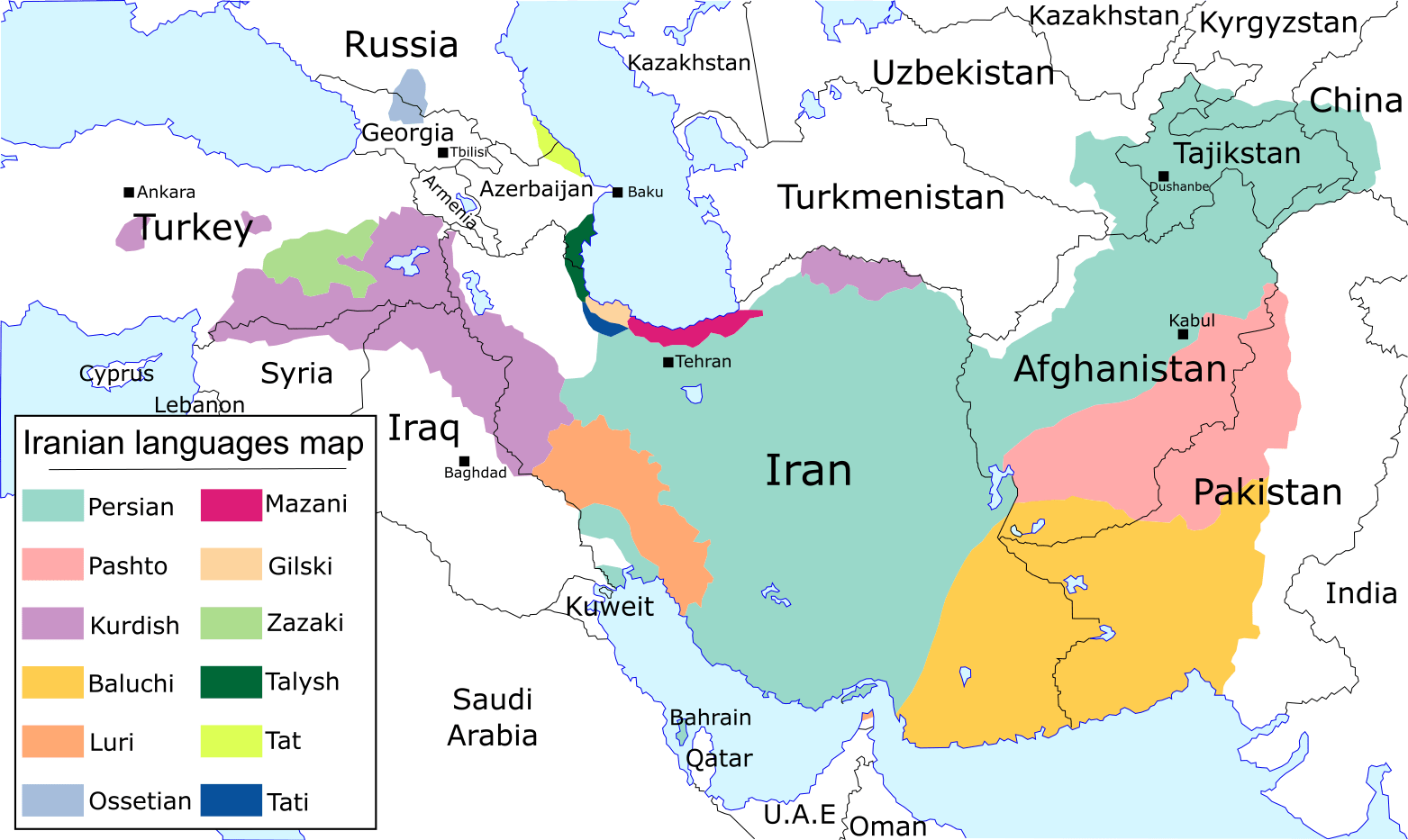
Persian today is the official language of Iran, Afghanistan and Tajikistan. Some may know this language by the name of Farsi which is an endonym of the language mostly in today’s Southwestern Iran. In fact, Farsi can be considered as only one of the main three dialects of the Persian language: the Iranian Persian or Farsi (), the Afghanistani Persian or Dari (دری), and the Tajikistani Persian or Tajiki (тоҷикӣ).

The term Persian is an English derivation of Latin Persiānus, the adjectival form of Persia, itself deriving from Greek Persís (Περσίς), a Hellenized form of Old Persian Pārsa (𐎱𐎠𐎼𐎿), which means “Persia” (a region in southwestern Iran, corresponding to modern-day Fars). According to the Oxford English Dictionary, the term Persian as a language name is first attested in English in the mid-16th century.

[…]

The Academy of Persian Language and Literature has maintained that the endonym Farsi is to be avoided in foreign languages, and that Persian is the appropriate designation of the language in English, as it has the longer tradition in western languages and better expresses the role of the language as a mark of cultural and national continuity.

(From Wikipedia)

But why on earth one might want to learn Persian as a language? Well, amongst countless reasons, I will give you five:

1. It Works As the Best Bridge Language

Persian is much easier than you think. It may sound as distant and exotic at first to you, specifically because of its different alphabet, but once you start learning, you’ll see it is much more familiar than you had thought. The most important thing about it is that it is an Indo-European language. So it shares its roots with English, German, Spanish, French, and many other languages that you may know as your native or second language. You will quickly notice the similarity of grammar and vocabulary. But at the same time that it is very easy to learn, it opens up the door for learning many other Eastern languages. From one side, it is closely related to Hindi, Punjabi, Urdu and many other Indo-Iranian languages (Hindi alone has more than 300 million native speakers); this kinship helps you learn those languages, later, while they are harder than Persian, since Persian is one of the most simplified offspring of Indo-Iranian language group (For example you do not have to deal with noun cases or gendered words in Persian, they do not exist). From the other side, Persian alphabet is a modified version of Arabic alphabet, and about 30% of the vocabulary of Modern Persian are Arabic loan-words; Thus, it also paves your way for learning Arabic (one of the six official languages of the UN) and related languages, while at the beginning you do not have to deal with difficult grammar of Arabic (which is from Afro-Semitic language Family).

Indo-European language family has become the first language of about 45% of the world population.

2. It Has an Unbelievably Rich Literature

The quotes by Rumi are becoming viral in social media these days. Many who like poetry know Omar Khayyam. Everyone who has studied Goethe knows that he was immensely influenced by Hafez, and Shahnameh is the second longest poem in the history of the world after Mahabharata, and it is almost 4 times longer than Homers Illiad and Oddyssey combined. But it is not only the classical Persian literature that is interesting. Many Tajik, Afghan and Persian speaking Indian poets and writers have influenced the whole literature of Asia with their work. Figures like Forough Farrokhzad, the first woman who wrote about femininity and pleasure in Persian, and Houshang Golshiri, who revolutionalised the native fiction writing, have been translated into many different languages. Sadegh Hedayat’s “The Blind Owl”, a surrealistic novel, is one of the most famous originally Persian works known all around the world. Even Persian speakers who write in other languages have the trace of Persian literature in their work, like Azar Nafisi, Marjan Satrapi, Shahrnoosh Parsipour or Reza Baraheni (who was the president of Pen Canada Association). If by any chance you are a reader, and if you are anything like me and believe many things will be lost in translation, learning Persian gives a huge corpus of texts to explore.

Not Only Literature Written In Persian, But Literature Written in English by Persian Speakers Has The Trace of That Poetic Culture.

3. It Has a Very Vibrant Contemporary Culture

Persian speaking community are amongst the most educated people in the world. Iranians are one of the most modernized and progressive communities in the Middle East, along with Turkish and Egyptian people; Tajikistan has some of the best universities, museums and cultural centres in central Asia; and the only reason Afghan community has not thrived as much as the other two countries was the long history of war and extremism inside the country, not lack of talent or cultural background, as it is obvious in very successful Afghan expatriates (like Annet Mahendru or Khalid Hosseini). Tajik people have kept the Iranic culture in its purest form, and their country is both culturally and economically a successful nation and a point of pride for its people. Iranians, were the people who started the first women-led revolution of the history of mankind in 2022, they are very open minded and proponents of ground breaking changes. The Afghan writer and director, Atiq Rahimi, showed one of the first nude scenes in a Persian speaking movie in his masterpiece, “The Patience Stone” (2012), just a year after Asghar Farhadi won the first Oscar for a Persian speaking movie for his film “The Seperation” (2011). In many countries of the world, there are Persian speaker diasporic people who are engaged in the global trends. Jila Mossaed the Iranian poet, is the first non-Swedish member of Nobel Academy, while Abbas Kiarostami the Iranian Director is the first Middle Eastern winner of Akira Kurosawa Award. You may as well have a Persian speaker as your co-worker or neighbour if you are living in North America, Europe, Oceania or East Asia. Persian culture, architecture and music has been recognized by the UN (including many cultural events, like Nowrouz). Learning Persian opens up a lot of cultural and artistic doors which are at the highest levels of the world to you, and you can communicate with these masterpieces without the need of a translator, or visit these beautiful countries like Tajikistan.

The Salesman Was The Second Movie by Asghar Farhadi Which Won An Academy Award.

4. It’s Not as Impractical and Rare as You May Think

Persian Language can be practical in many respects, of which I mention three. The first one is what I already mentioned, it is the language of some of the best artistic and cultural works of the Middle East, and one of the most beautiful travel destinations of central Asia. The second practical aspect of it is its usefulness in the historical context. As mentioned again, this languages bears the majority of human race’s advancements until the 17th century. Not only it has been the language of Persian Empire (which used to rule from Mesopotamia to Indus River for most of the History), but also it has been the official language of many dynasties in India, and also in Ottoman Empire. Given the fact that before the enlightenment in early 18th century, most human developments and advancements were being done in these three regions (in addition to the Islamic Empire in Arabian peninsula and Northern Africa, of which many thinkers were also fluent in Persian), Persian has been the Lingua Franca of the most important region of the world from the fall of Roman Empire until the beginning of Enlightenment and its bastard offspring colonialism. Persian played the same role in central and western Asia, as did Latin in Europe. So, in any study of the culture and history of the region whether as a hobby or as a profession, knowing Persian is an asset. The third practical aspect is the current Geopolitics of the Middle East, and the important role of Iran (and the threat of Taliban-ruled Afghanistan). Knowing Persian actually can secure a lot of jobs, related to foreign affairs, and cultural studies, as well as governmental administrative work, or even charity work (I personally volunteer for interpreting for Afghan refugees in Canada). Persian is not rare either. Not only it has more than 130 million speakers (as either first or second language speaker) in the region, there is an estimated 20-25 million Persian speakers scattered around the world. The U.S. itself has about 1 million native Persian speakers citizens (meaning that this number does not include non-citizens like refugees, international students, or foreign workers). Therefore, at least 150 million people speak Persian fluently as their first or second language around the world, which is about 2% of the world population (to understand the greatness of this number, I should say that the speakers of a famous language like Italian as a first or second language, are less than 1% of the world population). Thus, knowing Persian is both practical and useful for communicating with a large audience.

Map of Persia (Yellow), Ottoman Empire (Red) and Arabian Territories drawn in 1753 C.E.

5. It’s an Adventure

Let’s face it: In the modern world with Google translate and many other AI-based language tools, learning languages are becoming more of a hobby than a necessity. And learning any language is an adventure. None is by no means better than the other. Persian language, however, has its own specificities which give it its own adventurous qualities. It is a very poetic language in nature. There is a reason that it has one of the richest literatures in the world. Even its everyday conversations are full of metonymy and metaphor and are poetic and flowery; not that people put any effort into making it like that, that’s just an attribute of the language. It has been chosen as one of the top 10 best-sounding languages of the world in two different public surveys. It is very dreamy and imaginative, as well as beautifully sounded and smooth. Personally, as a native Persian speaker, find only one language more musical than Persian, and that is Italian (although I do not understand a word, I still enjoy listening to their music or poetry recitations). It has also a long and interesting history, going back at least three thousand years, which gives you a lot to explore. Another interesting quality is that it hasn’t had any major change in the last millennia, and you can understand the poetry of Ferdowsi, written in the 11th century, just as well as you can understand young adult fiction of the 21st century. While Old English refers to English before the Norman conquest of 1066, the Persian of 1066 is considered Modern Persian. While Old Persian is referred to as the language of the Achaemenid Empire of about 2500 ago, Modern English is believed to be the English used after the 16th century, including works of William Shakespeare, which many native English speakers cannot read today. This aspect of Persian has made many texts (Essentially anything written in the 10th century) available to the modern reader. Learning Persian is also an adventure because the culture has always been a point of curiosity for people around the world. The mention of this curiosity can be found in many travel writings and even historical and philosophical works written in many different languages. It may go back to the curiosity of Greeks during the Greco-Persian Wars and the writings of people like Herodotus. By learning this language, you can get closer to this unique culture, study one of the oldest religions of the world (Zoroastrianism), and in addition to Tajikistan that you can visit safely right now, with crossed fingers, soon enough Iran and Afghanistan will become free and safe countries again, and you can travel and communicate with the people first-handedly.

Middle Persian (Pahlavi) writing (Top) compared to Modern Persian writing (Bottom)

I hope you have found this post useful. Let me know what you think in the comment section. Do you have any experience with or interest in the Persian language? Do you like to learn this language someday?

Real Story of Haft Sīn

Correcting a Common Misinformation About “Haft Sīn” Table

The Earth will be positioned exactly at the point relative to the Sun in less than seven hours from the time I am writing this post. Scientists call this point “The March Equinox” but my heritage culture calls it “Norūz” (I explained the importance of astronomical events in my post about “Yaldā”). This point marks the beginning of Spring, and for Iranic people, the beginning of their ancestral calendar.

Photo by Fatemezahra Khavand on Pexels.com

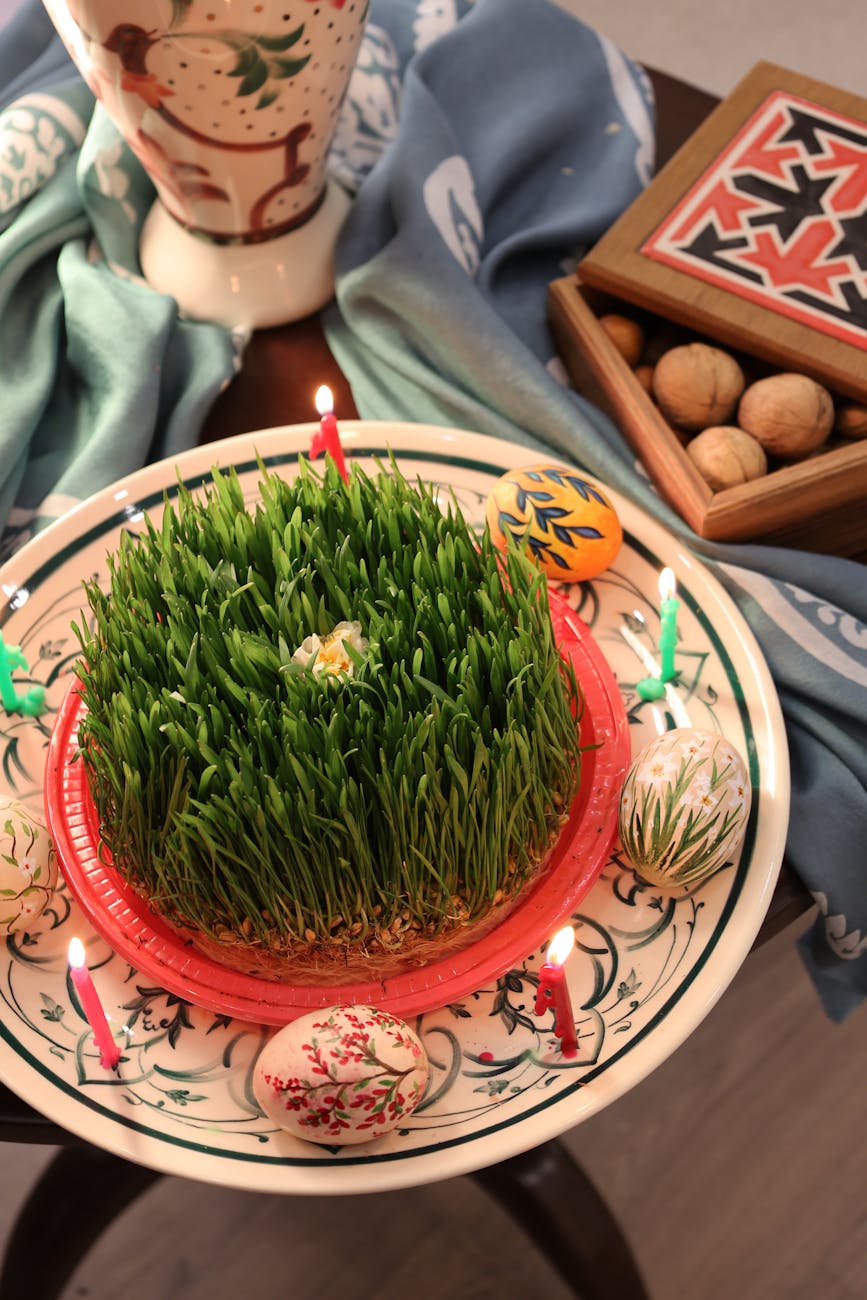
Norūz is usually associated with the “Haft Sīn” Table (Photo Above), although this costume is mostly limited to Iran and Northern/Eastern Afghanistan. In fact, more than half of the people who observe the tradition of Norūz, do not recognize “Haft Sīn” as a part of it. This fact aside, what usually is said or written about the “Haft Sīn” Table has basic flaws and terrible misinformation. I don’t want to get into long and boring details. Let’s briefly get to the bottom of it! The most common explanation you find about “Haft Sīn” is that it consists of seven items (“Haft” meaning “Seven”). These items start with the letter “Sīn”, which is the equivalent of “S” in the Perso-Arabic alphabet. You might even see “coins” or “clock” as suitable items since their Persian equivalent starts with the /s/ sound. However, both words in the name of this costume are problematic! So, what is the real “Haft Sīn” you might ask?

The authentic form of this tradition goes back to at least 1800 years ago, to the late years of Parthian Empire. It does not have seven items, but nine, and for a good reason. “Sīn” is a word from old Iranic languages which is cognate with “saint” or “sacred”. Simply put, they have the same Indo-European roots. So, this costume is putting nine “sacred” items somewhere in the house, for the new year. Ancient Iranic people believed in three natural elements and three binary forces in the universe that are represented symbolically in the nine original items of “Haft Sīn”. That makes nine! The three elements were 1) Earth (related to body), 2) Water (related to mind), and 3) Sky or Air (related to spirit). You may ask what about Fire? This brings us to the first binary force: Asha, which is the innate truth of the universe and all luminaries including fire, and its counterpart, Druj, which is the deceit of the creation and all tenebrosities! The second binary force: Zurvan or temporality, and its counterpart Gathan, or spatiality! And finally, the binary of Vahu Mana or good intention against Aher Mana or evil intention.

AI-Generate concept photo depicting a good estimation of Parthian clothing, buildings, and probable items on the table set for the historical festival of Norūz

Finally, if you want to ask: Okay, enough history, what are the actual nine items? The answer is: that nobody really knows. We know with certainty that “Red Wine” used to be one, which was replaced by “Vinegar” at some point. We know there must be one item representing light (usually candles) for Asha. One item represents the reversed and deceitful image of reflection (usually a mirror or a bowl of water), representing Druj. We are also sure that green sprouts should definitely be there, representing the Earth and its revival. The rest is just guesswork! Our only certainty is that all other items are one way or another coming from nature and they are directly or indirectly edible. Whatever they are, at some point they used to symbolize time, place, air, water, and good and evil intentions. For example, some say a sweet and a bitter food item used to be symbols of good and bad intentions. This corresponds to the aromatic sweet Apple (“Sīb”) and the pungent bitter Garlic (“Sīr”) in today’s “Haft Sīn”.

The theories about the original form of this tradition may vary. However, it is important to keep it alive. And the same goes for preserving any other cultural heritage from every corner of the world. And this spirit:

Happy Norūz!

Wording, Phrasing, and Paragraphing in Academic Writing

Wording, Phrasing, and Paragraphing in Academic and Professional Writing

I have been working as a Teaching Assistant for 13 academic terms, at the time of writing this post. I also have been a writing tutor at the writing centre of a prestigious college in Canada. Finally, I have been a language teacher for more than seven years, dealing with my students’ writing assignments. Many people probably have more expertise on the subject than I do. Yet, I thought I could put my experience to some use. I wanted to provide students and entry-level staff with some rules related to professional and academic writing.

It should be addressed first that not all professions need to write academically, nor do all disciplines in Academia follow the same writing style. However, there are essential things in common amongst them on which I intend to put more emphasis. Wherever I know something is not a universal rule, I mention the field the rule applies to. Also, each language has its own conventions, and the suggestions of this post are just for English writing practices. Finally, my focus is more on the academic side of the conventions. In that regard, after Crafting a Thesis Statement, wrong Word Choices and inefficient Paragraphing are the most common mistakes I’ve encountered in people’s writings. So, let’s talk shortly about wording, phrasing, and paragraphing in academic and professional writing.

Wording

“Wording” is a term I am using here liberally. It refers to the choice of words and their diversity. It also covers their collocations and their effect on the reader. Additionally, it includes practices to address these issues.

Word Choice & Collocations

I can say with confidence that after thesis statement problems, bad “word choice” (on par with bad “paragraph structure”) is the most common writing problem. While the thesis does not apply to professional writing, this one does. Therefore, it is safe to say that in non-academic professional writing “word choice” is the number one issue. But what is the problem and how can we fix it? The problem is usually one of three things: incompatibility of word with the phrase, wrong emotional load, and limited vocabulary.

First, you should always make sure that the words you use read well in the sentence. This is partially a matter of opinion, but also partially an objective (or conventional) element. The opinion aspect is a stylistic choice; it is what makes you the writer you are. The conventional one is related to the reader’s side; it is mostly (but not completely) related to sounds. Your word should be a conventional word. The reader expects to see it in the context of the writing. However, it should also “sound” good. It means you should re-read your sentences to certify words that add up progressively do not create undesirable or hard sounds. For example, in the previous sentence: 1) “re-read” is not desirable with repetition of /ri/ sound, 2) “add up progressively” is hard to read, unnecessarily long and two /p/ sounds following each other, and 3) certify is just not conventionally a word we use in this context. “Certify” also does not match the tone of a blog post. A well-chosen word considers the tone, the level of formality, and the audience.

Second, you need to consider the word “collocations” in English. Not every word can sit well with every other word. Possibly, you cannot find any hard and fast rule about it grammatically. However, the conventions of English speakers provide a pragmatic context. Some words come together more frequently, some “can” come together at the discretion of the writer, and some just do not feel right. For example, imagine the word “light”. It is common for it to be described as “bright light” or come in the phrase “to shed light on”. However, it sounds weird if I say “refulgent light” or use the phrase “drop light on”. This is while “refulgent” and “bright” are synonyms, as are “shed” and “drop”. This problem specifically occurs in the writings of people who acquired English as a foreign language and are not native speakers.

Conclusively, correct work choice and correct collocations lead you towards avoiding repetition. This is a big problem. It signals limited vocabulary. This is never received well in academic or professional writing, specifically in humanities and social science contexts. I usually say that as a rule of thumb (and not Gospel truth), you should have at least 2-3 sentence intervals between repetitions. In other words, if you use the word “light” in a sentence, make sure to write at least two full sentences before using it again in the third sentence. But what if you really need to refer to the idea of “light” in those two sentences? In academic writing, there are two possibilities. If it is an irreplaceable technical term, there is no choice but to repeat it. Alternatively, you can restructure your sentence order. However, in official writing where there is no terminology restriction, there is no justification for repetition. Both in professional writing and academic writing where the repeated word is not irreplaceable, you should find a good synonym. This brings me to the next section.

Thesaurus & Connotations

In order to avoid repetition, you need to find synonyms. Obviously, the traditional way of doing that is with dictionaries. Before the digital age, there used to be “Thesaurus” books, but they were barely better than a good dictionary. However, starting with MS Windows and the Internet becoming commonplace in the 1990s, personal computers offered us many tools. These tools are sometimes better than a dictionary. The most famous online tool is the website https://www.thesaurus.com. Yet, MS Word has an internally built thesaurus which works just as well, and is faster to use if you are a Microsoft user. By using a thesaurus, you find synonyms for the words you don’t want to repeat. However, it is a blessing and a curse. When choosing a synonym, you should consider everything mentioned above (sounds, collocations, etc.) as well as the “connotation” of the word. Simply replacing a word with the synonym you find can end up being disastrous.

Some may ask, what is the “connotation” of words? It is the emotional, cultural, and implied meanings associated with the denotation (dictionary meaning) of each word. I had this discussion with students a few times. For example, one of them had described a court case about murder using the adjective “captivating”. It is problematic because the denotation of captivating is “capable of attracting and holding interest.” However, the emotion connected to this “attraction” is extremely positive for the average English speaker. Using it for a murder case is a poor word choice for that reason. It just does not sit well. Meanwhile, for describing a motivational speaker, “captivating” makes sense, as does “engrossing” (neutral) and “enthralling” (negative) for the murder case. I used to think this is also a problem significantly more common in people whose native language is not English. However, I realized through experience that it is even common in many native speakers. This happens if they are not book readers or avid media consumers (and thus have a limited vocabulary and a vague understanding of connotations). Therefore, while it is important to use a vast vocabulary, you should always be sure of the connotations. Whether you come up with a word or you find it in a thesaurus, check if the emotional and cultural associations are right. Dictionaries usually mention if a word has a positive or negative connotation (specifically if it is a strong one). But an online search will also provide you with answers in forums and Language websites.

All of these are aspects of choosing the right word. While they are general suggestions and main things to consider, at the end of the day, you are the author. Many times, you may even be unsure about a word before thinking about any of these concerns. It might have happened to you that you just feel a word does not “feel right”, but you do not know how to remedy that. I can say two things. This time, they are not based on my experience as a writing tutor. They are based on my personal practice. First, whenever you do any of the practices above which lead to using a new word, make a mental note of that word. It is not just enough to know the word, as you probably already knew it before checking the thesaurus. You want it to be your active vocabulary, and you want to be aware of its connotations. Second, in my creative writing, although totally different from academic or professional writing, I have developed a personal trick. When I feel a word does not “feel right”, I come up (myself) with 3-5 substitute words. They can be synonyms or words very closely related in meaning. Then I check these 3-5 words for synonyms and connotations. During this process, I find at least one synonym for all or most of the 3-5 words over 70% of the time. If the connotation is correct, it’s possibly what I am looking for. The similarity shared by all or most of my substitute words shows a common trait. This word with the shared aspect must feel more “right” than each word individually. I use this mostly for poetry or fiction writing. It might not work for academic writing “all the time”, but it is a personal method I devised which can help you “sometimes”.

Phrasing

“Phrasing” is also used liberally here. It refers to the groups of words that are syntactically related and the way they make better sense. It also covers the connection of these groups to form a complete sentence and the grammatical concerns associated with sentences. Additionally, it includes practices related to the necessary qualities of a good sentence.

Phrase Structure & Qualities

Phrases are groups of words that are not a full sentence. In English, any sentence is comprised of an argument and a predicate (see the next section). A phrase, broadly speaking, is an argument with no predicate or an incomplete predicate without an argument. So, more broadly, a phrase is part of a sentence because, unlike a sentence, it does not convey a full idea. Grammatically speaking, most parts of speech can form a phrase around them: Noun Phrase, Prepositional Phrase, Verb Phrase, etc. Put it in less technical terms, most words can be the centre piece of a phrase. So, the structure of a phrase is a group of words related to a central word when either the argument or the predicate is missing. For example, a “Participial Phrase” (where a past participle or a present participle comes as an adjective) usually begins with a participle and forms an incomplete predicate. An instance of this is the italicised phrases within these two sentences: (1) Throwing rocks across the water, my brother smiled.” (“Throwing” as present participle, a subjective adjective that describes the action of the brother as the subject of the sentence) (2) “Chaucer’s Canterbury Tales, written in Middle English, is considered a literary masterpiece”. (“Written” as past participle, an objective adjective that describes a quality of the object as additional information to the main sentence.)

While getting into the structural details of all kinds of phrases takes a much longer post, there is a set of rules and qualities you should have in mind about your phrases. First, decide your punctuation based on whether the phrase is “essential” or “non-essential”. It also determines the placement of the phrase within the sentence. Essential phrases are phrases without which the sentence loses its meaning (Example #1 above). Non-essential phrases merely add to the meaning, but the sentence is still valid without them (Example #2 above). Here, some may even bring up the difference between phrases and clauses (a subcategory of phrases). Second, always ask yourself if a non-essential phrase makes your sentence clearer or longer. If the answer is not a certain “clearer”, you are probably providing unnecessary phrases. Third, if you are dealing with rhetorical phrases (used for making the text more beautiful or relatable), their placement shows their quality. Usually, the ones that you put at the beginning of the sentence (e.g., “In a nutshell, …”) tend to be more essential (and clarifying). The more it moves towards the end (e.g. “… two wrongs making a right, …”), the more probable they will be less essential (and unnecessary). Fourth, phrases can come as pre-position, ad-position, or post-position. Simply put, they can be at the beginning (e.g., “While implementing this experiment, …”), in the middle (e.g., “…, in order to save time, …”), or towards the end (e.g., “…, considering the affecting factors.”) of the sentence. It is not always easy to judge if any of them are more essential than the others. Yet, it is advisable to avoid using essential phrases as ad-position (middle) and preferably use them at the beginning or the end of the sentence. Fifth, and finally, as phrases are a group of words connected to a core, the core word decides the placement and length of the phrase. By correct recognition of the core word, you enable yourself to do two things. You place the phrase in the right part of the sentence based on the grammatical role of the phrase (e.g. Subjective Phrase, Adverbial Phrase, etc.). You can also shorten the unnecessarily long phrases by removing the words that have less important connections to the core (“While implementing this experiment, …” can be “During this experiment”, since the core idea is “experiment” and the time duration is less central, so it can be shortened).

Sentence Structure & Length

As said above, an English sentence has two main components: the Argument & the Predicate. The simplest example of this is Subject + Verb Phrase, like “Academic writing + increases critical thinking.” Of course, an argument can be a much more complicated noun phrase, and in some cases, it may not even contain a subject, but it always establishes the main focus of whatever idea the verb is going to discuss. Predicates can also take multiple forms and have much longer structures. At the end of the day, you need to make sure that your sentence has at least these five qualities: First, it must have a point that it wants to make (argument), usually in the form of telling someone’s (subject) action or something’s (object) being affected in a way. Second, you have to be very careful about “Subject-Verb Agreement”. Missing this point is an extremely common mistake in writing, even amongst native speakers. Third, if your subject consists of singular nouns connected with “or”, you need a singular verb. Also, if it is a collective noun referring to a group of people (e.g. “The Committee”), it requires a plural verb, while when it is a collective noun referring to one entity of several people (e.g. “The CNN”), it usually comes with a singular verb. Fourth, it must have a verb to be a full sentence, and the verb cannot be the first word in a grammatical sentence. Fifth, if you have more than one verbal phrase, you have to follow “parallelism”; it means your verbs should be in the same tense/form.

In terms of general structure, the word order of the predicate is always “… + Adverb + Verb + Object + …”. While other elements can come before the adverb or after the object, these elements are so common that you need to consider them as the cornerstone of your sentence structure after your argument (usually the Subject). Moreover, even if your argument is not a simple subject (e.g., Passive Sentences, Questions, etc.) or your predicate has many components other than the verb (e.g., Complement, Auxiliaries, Prepositional Phrases, etc.), a correct and fully-formed sentence always needs both of them. When a sentence lacks a valid argument or a complete predicate, we are dealing with a “sentence fragment”. Having these structural points in mind, you should be careful not to let your sentence turn into a fragment, nor should it expand into what is usually called a “run-on sentence”. A run-on sentence is when you could divide a sentence into two separate thoughts without adding, rearranging or removing a single word. Correct use of punctuation and not connecting multiple arguments and predicates will help you avoid this. An academic sentence is usually between 15-25 words. If, for justified reasons, you need to make it a little shorter or longer, you must still keep it within the 10-30-word range. Anything shorter or longer than that is either a fragment/run-on sentence, or becomes automatically vague because of being too short/long.

Photo by Victor Moragriega on Pexels.com

Paragraphing

“Paragraphing” is a more common mistake than any of the above concepts. It is also the most important of all. “Paragraphing” involves dividing writing into independent but connected chunks. These are groups of sentences focused on a single idea or topic, which are also in harmony with other groups. It is the practice of creating these independent structures from basic components. “Paragraphing” also ensures the coherence of the whole text and its comprehensibility for the reader. Additionally, it includes practices to address the issues that can negatively affect readability or coherence.

Paragraph Structure & Components

Paragraph Length & Transitions

Christmas, Winter Solstice, and Yalda Night

Christmas, Winter Solstice, and Yaldā Night

Have you ever heard this idea that, based on both biblical and historical evidence, Jesus was most probably born in July or August?

Are you familiar with the astronomical concept of Winter Solstice?

Do you know anything about the Iranic custom of “Yaldā” and its relationship to many ancient Indo-European beliefs?

A traditional Iranian (mostly Persian & Luri) Yalda Night – Photo from HeyPersia

I am going to briefly answer these questions here, and introduce the Iranic festival of Yalda Night (or Shab-e Cheleh شب چله) and its corresponding cultures:

The Four Astronomical Events:

Iranic culture has an unbelievably close kinship with nature, and many of the beliefs and rituals since two millennia B.C.E to the date have been in exact harmony with the events in the natural world. In this multitude of natural phenomena, four Astronomical events stand out. They have been the basis of Iranic Calendar since at least 1000 B.C.E. They are still observed as four of the most important ceremonies by people of Iranic culture all over the world. And they proved to be accurately calculated to the second when compared to the scientifically calculated numbers. These four events are the two equinoxes and solstices.

The Two Equinox and Iranic Beliefs:

The Two Equinoxes have been the symbol of natural harmony in Iranic culture. They represent an inherent quality of the universe. This quality is Equal Balance as the True Order of things and manifests itself in these two celestial events. It is embodied in the equality of darkness and brightness. Vernal Equinox (March or Spring Equinox), scientifically marks the beginning of Spring. The revival of nature marks the start of the cyclical movement of time. Therefore, it is the Iranic New Year or Norouz in the Iranic Calendar. It is observed by Iranic people in Afghanistan, Albania, Azerbaijan, Iran, India, Kurdistan, Uzbekistan, and Tajikistan, amongst other countries. The Autumnal Equinox (September of Fall Equinox), marks the beginning of autumn. It was demise of nature and the time of autumnal harvest celebrated by a dance festival. Both equinoxes were celebrations of the god “Varuna.” Varuna was the god of skies and the keeper of balance in the universe. Zoroastrianism later turned “Varuna” into “Mazda” (literally meaning “The Great Knowledge-bearer”). Subsequently, the fall equinox later turned into the “Mehregan” celebration, while Norouz became associated with “Mazda”.

Summer Solstice and Midsommer:

Stonehenge – Photo by Samuel Wölfl on Pexels.com

Many might have heard about the Germanic celebration of Midsommer, still being observed in Northern Europe and Scandinavia. Many other cultures celebrate the Summer Solstice. On this day, days start to get shorter. Iranic people also celebrated it – originally – as the day when the god of moon and darkness (Mangha) is born. Later, again in the changes that Zoroastrianism brought to the culture, it turned into the “Tiregan” celebration. In general, this date is more prominent for Indo-European cultures, like Germanic people, Indo-Iranians, or Celts. Stonehenge, in almost every scientific speculation, is considered to be a form of celestial calculator of the two Solstices. But other cultures also celebrate this natural event. Incas celebrated “Wiñoy Tripantu” on this day which was the beginning of their New Year.

Winter Solstice and Yule:

Germanic people, also have the famous Yule celebration on Winter Solstice. This was celebrated as a big feast, which was later adopted by the Roman Empire. On Winter Solstice, unlike its summer counterpart, days start to get longer. This celestial moment forms the basis of another festival amongst Slavic people known as Koliada. It used to mark the beginning of their year. Once again, the Roman Empire appropriated the word as the name of the first day of their year. The English word “Calendar” is derived from this root! For Iranic people, it was the birth of the god of Sun and brightness: Mithra. They used to celebrate it all through the night, giving homage to Mithra. This later gave birth to the religion of “Mithraism” from one side, and the practice of “Yalda” from the other.

Paganism, Christianity, and Yaldā:

Mithraism left Iranic territories very soon and found followers in the West, while Zoroastrianism was replacing it at home. Zoroastrianism (through its short-lived predecessor “Zurvanism”) introduced Mazda. Mazda had the roles of Mithra and some of Varuna’s together. The new beliefs gave some other qualities of Varuna and all of Mangha to the evil deity “Reymana” (or later “Ahermana”). Finally it gave the remainder of Varuna’s roles first to “Zurvan” (the god of time and existence) and later to a minor deity “Verethragna”.

Mithraism and Its Roman Adaptation:

Dies Natalis Solis Invicti – AI generated photo

At the same time, Mithraism somehow became the prevalent religion in the Roman Empire. It was both adopted and appropriated (similar to Midsommer, Yule, and Kuliada). Even the names of the weekdays (as we see in English as well as Latin languages) are adoptions and appropriations. The day of the Moon (Mangha), Sun (Mithra), and the Sky (Varuna, early Iranic, Verethragna, Zoroastrian, and Tiwra, Germanic) followed the Mithraist beliefs. Monday (Moon’s Day), Sunday (Sun’s Day) and Tuesday (Tiwra’s Day) are still in use. As a result, many of the original Mithra-related beliefs were adopted into the culture of Romans and expanded across Europe. One obvious example is having the day of the sun (Sunday) as the day of worship. Another, was the importance of winter solstice and seeing it as a “Holy Night”. It now had a new name: “Dies Natalis Solis Invicti” or “The Birthday of Invincible Sun”.

Constantine, Council of Nicaea, and Gregory XIII:

When Emperor Constantine declared Christianity to be the official religion of the Roman Empire, many did not welcome it. There was a dire need for some kind of compromise. They needed to attract peasants who were not inclined to leave the gods of their fathers. They also had to satisfy many powerful people who had already converted to Christianity. The result was the Council of Nicaea. A big group of Christian leaders from different sects gathered consulting political advisors, Senators, and tribal elders. Many pagan beliefs entered their way into Christianity in those debates and spread like wildfire across the globe after that. Without a doubt, Mithraism was one of the most influential of these beliefs. One of the very obvious Mithraic beliefs was the trinity: Mithra, Luna, and (by the time of Roman appropriation) Jupitra. Jupiter (literally: Sky Father) gave his role to “The Father”, Mithra (the most esteemed deity) to “The Son”, and “The Holy Spirit” was invented to replace Luna. Another important Mitraic adoption was “Dies Natalis Solis Invicti” which suddenly became “The Birthday of the Savior Son”!!! Jesus’s birth date was moved from July to December 21st, the Winter Solstice. But why, if it is the 21st, today we celebrate it on the 25th? The answer is the Roman Catholic calendar. It did not have any mechanism for correcting its annual errors. Over the years, Christmas and other religious holidays moved up to a month. Finally, a more accurate calendar ordained by Pope Gregory XIII solved the errors. We still call it the Gregorian calendar. They tried to calculate the existing errors and revert them. However, in the end, a four-day error remained unaccounted for. Thus, “The Birthday of Invincible Suon” ended up on December 25th.

Iranic People and Significance of Yalda:

A Recreation of Yalda Table – Creative Commons Photo

Iranic people, are a group much bigger than just Persians or people with Iranian nationality. A cultural group who have close historical connections for more than four millennia; they live from the banks of the Tigris River to the Indus River, and from the shores of Oman Gulf to the Aral Sea. They are descendants of early Indo-Iranians (a Branch of Indo-European people) and mixed with Eastern Semites and Southern Turkic peoples. Almost every ethnic group under the umbrella term of “Iranic people” observes Yalda to the date. This includes Persians, Kurds, Lurs, Baluchis, Afghans, Tajiks, Hazaras, Azeris, Mesopotamian Arabs, Armenians, Georgians, Turkmens, Uzbeks, Kashmiris, amongst many others. Yalda is extremely significant for Iranic people. The old belief in the prominence of Light as the ultimate Good is still in the collective subconscious of the people. Therefore, the birthday of the Sun is particularly important. It might be the most prominent Iranic ceremony after Norouz (the New Year). The latter, usually March 21st on the Gregorian Calendar; the former, December 21st. As mentioned, however, Iranic Calendar is different, and therefore it provides different dates. It is the official calendar of Iran and Afghanistan and is recognised by many other countries like India, Tajikistan, Iraq, and Azerbaijan. Yalda is the last day of the ninth month on the Iranic Calendar. It precisely marks the end of autumn and the beginning of winter, which is the longest night of the year. As the night is correlated with the return of charity and prosperity, the red colour (representing warmth and light) and the pomegranate fruit (representing abundance and fertility) are central to its symbology.

Costumes, Rituals, and Celebration of Yalda:

The word Yalda itself is from Syriac roots, meaning “Birth” (referring to the birth of Sun-god Mithra or the Light). In some areas like Kashmir, Tajikistan, and the North of Afghanistan, it is called “Cheleh” (Fortieth). In ancient times, they used to divide the winter into three forty-day periods. Yalda marks the end of the first period (Minor Cheleh) and the beginning of the two upcoming colder periods (Major Cheleh). It is speculated that ancient Iranic people might have called the night “Mehrizad”, meaning Mithra’s Birth. There is nothing more than speculation about how the night was celebrated, but holding a vigil, gathering around a fire, eating pomegranate while telling stories, and drinking wine are amongst the common speculations. Yalda is observed by Zoroastrians, but it has lost its importance in relation to nearby celebrations like “Azargan”, although it is still a holiday.

Modern rituals of Yalda are different for each region, but holding a vigil, gathering and reciting poetry, and setting a Yalda table are traceable in most of them. A Yalda table itself can have different elements. Yet, pomegranate fruit, Red Wine (or another red drink in more strictly Muslim households), Watermelon, and Mirrors and Candles can usually be seen. While Persians tend to recite poetry of Hafez on this night or even exercise the practice of Fal-e Hafez, Lur and Bakhtiari peoples prefer Shahnameh. Persians also put assorted nuts on their Yalda table, while Azeri people put dried figs and stews. Kurds of western Iran and eastern Iraq have dances and fireworks on this night, while Kurds of eastern Iran and Herati people of Afghanistan use this night to give presents to newlyweds and engaged couples. And through many other costumes and rituals, this night stands as a testament to the enduring cultural heritage of Iranic people, embodying resilience, hope, and unity. Something that the modern world is trying to rob them of on a daily basis …

Liberty Has Always Been An Exposed Woman
Liberty Has Always Been An Exposed Woman

On Detriments of Asking for Enough

“Lady Liberty Leading the People” by Eugène Delacroix

“Liberty Leading the People” is a painting influenced by the French Revolution, painted in 1830, and since has been a symbol for all revolutionary movements. In this painting, Liberty is a bare-chested woman, quite similar to the 21st-century activists of the #Femen movement. Why is it that about 200 years before even the idea of Femen was born, Liberty was painted as a woman, and not any woman but a semi-nude woman? What is it in womanhood and being exposed?

It is the mere “Radicalness” of it that makes it liberating. Women have always been suppressed, in most if not all cultures, and they have never been the leader. They have been considered devoid of ideas, courage or sound judgement, all qualities necessary for leading. Women have always been the safety valve for imposing the social norms and keeping the “status quo”. They have been controlled through the body politics of gender, to reinforce conformity.

An act is only revolutionary if it is “radical”. When an act or a movement tries to keep the “Social Norm” and make just some necessary adjustments, for a better situation, the act unintentionally ends up reiterating the standards of the status quo (without knowing it). The result of course will be no actual change, but a reassemblage and a reordering of the social features which created the need for change in the first place. That is why the majority of social movements never actually made any tangible change. Suffrage movements changed the appearance of the place of women in society, but they neither changed patriarchy, nor the hierarchical inferiority of women, and not even the commonplace misogyny. Just like all the acts towards #truthandreconciliation in Canada are mostly performative slogans and empty shows and still, there is little to no change in Indigenous lives.

“The more radical the person is, the more fully he or she enters into reality so that, knowing it better, he or she can transform it. This individual is not afraid to confront, to listen, to see the world unveiled. This person is not afraid to meet the people or to enter into a dialogue with them. This person does not consider himself or herself the proprietor of history or of all people, or the liberator of the oppressed; but he or she does commit himself or herself, within history, to fight at their side.” (Paulo Freire)

The problem is, usually radical acts are usually seen as ineffective because they can create defensive reactions. However, these very defensive reactions, as many cultural theorists believe, produce a fissure in society that can break down the social constructions of the “status quo”. On the contrary, avoiding radical acts for having the support of the majority, will be aiming for “good enough” and creating an environment of “conformity”. Therefore, asking for enough, and aiming for minimum change (sometimes with the hope of future changes, which for the reasons mentioned will never happen) is never beneficial for society. It is either a creation of more of the same (as in all feminist and anti-racism movements of the past two centuries) or even becomes the birthplace of a bigger evil (the case at hand for me is the 1979 Islamic Revolution in Iran).

Now that I have come to an example from my home country, Iran, I shall add one final point. As we approach the first anniversary of the murder of #mahsaamini (whose original Kurdish name was “Jina”, itself another case of oppression targetting ethnic minorities), we can look back at a movement that is still creeping under the surface layers of streets of Iran. This was, by the word of many political analysts and not me, probably the first revolutionary movement in history that was started and led by women. It was also unique in some other senses like not having a single leader and having many beautiful objectives like human rights, and environmental issues, amongst others. This is in fact like that famous painting, an aesthetic picture of a woman leader, who aims for the liberty of not just herself and her choice of clothing, but a revolt for the betterment of the whole society. The beautiful movement in Iran, as well as any other revolutionary movement, can only create real change if it creates that fissure, that crack, inside the society itself, if it does not want to reinforce the status quo of patriarchy (women’s rights issues) and cultural hegemony (ethnic rights issues). Otherwise, just like the French revolution that ended in the tyranny of Robespierre, it will lead the Iranian people inside another hegemonic system with apparently different (reordered), but fundamentally the same features.

Let us celebrate the anniversary of this beautiful movement, and push towards its goals more than ever, with #radical actions. Do not condemn people who are not satisfied with “good enough”, commend them, and praise their bravery and their commitment to be on the right side of history, more often than not, at the price of their own reputation.

Five “Genderless” Persian Names That Sound Great for Your Future Baby

Five “Genderless” Persian Names That Sound Great for Your Future Baby

People these days are trying to use diverse names and use the beautiful qualities of different languages to their benefit. As a native Persian, as long as it does not get the form of appropriation, I do not see anything wrong with it. Also, there are many second-generation Persian Emigrés in the West or mixed-raced people with Persian blood, who can have a Persian name without the risk of appropriation. In my post “Five Reasons to Learn the Persian Language” I mentioned that it is a completely genderless language. While there are gendered names in Persian which are either historically gendered (Old Persian used to have gender, but it lost this attribute 2000 years ago in its transition into Middle Persian) or they are conventionally gendered (people just decided to strictly use one name for one gender despite the genderless quality of the name itself), yet still there are names that are genderless, and I want to introduce some of them here, which I believe have both beautiful meaning and beautiful sound and can be used for Persian Emigrés, mixed-raced people, Persians in their original homeland, and even by foreigners who are a bit more adventurous. There is also this concern these days, with more awareness about trans people, that the gender assigned at birth will turn out to be the wrong gender, and by using a genderless name, parents can save the hardship of changing names in the possibility of their children turns out to be transgender.

1. Ashi/Ershiya (Ashu/Asha)

This name is used for both people who are assigned male and female at birth in Persian-speaking countries (or at least in my country: Iran). It comes from Asha (mostly female) or Ashu (mostly male) words in Old Persian and Avestan languages (which are very close to Sanskrit, so you may also see similar or identical words in Sanskrit). Ashi or Ershiya (as a derivation) means “truthful and honest human” while Asha & Ashu, more specifically, mean “Being in Harmony With the Truth of the World”.

2. Mantre (Mantra/Mantro)

The exact same story, while the old versions have a female (Mantra) and a Male (Mantro) version, this new form of the name which is pronounced with a long “a” and short “e” is genderless (IPA: /mɑtrɛ/). Mantre means “Soothing Words” in Persian. You may have heard Mantra (the female form) as it is a loanword in European languages either from their encounters with Persians, or Indians (who also have a similar word with a close meaning). In English, it tends to have the meaning of “a spiritual slogan” which is not far from its Persian meaning.

3. Mazda

A Japanese car company completely ruined it for us, and no, it is not a coincidence. The founder of the car company admitted that they have chosen the name from Iranic Mythology. Mazda was one of the ancient gods of Indo-Iranians, who turned out to be the main deity of the monotheistic faction of Zoroastrianism. The name, like all ancient Iranian gods, bears no gender in and of itself, although later, probably under the patriarchal influences of Abrahamic religions, it was more conventionally used for boys. Mazda is from Old Persian and Avestan roots, meaning “Immense Wisdom”, and is actually from the same Indo-European roots as the English word “Mind” and it is pronounced quite close to the name of that car company (IPA: /mæzdɑ:/).

4. Hurshid

It is a word constructed of “Hur” meaning the sun and “Shid” meaning the glow and it literally means “Sunshine”. In Contemporary Persian, in most but not all regions, it is pronounced as Khurshid and the meaning has changed to “the sun” in general, yet the older pronunciation shall be easier for non-Persian speakers. Hurshid is a name used conventionally for girls in central Iran, but for boys between Kurds, Bakhtiaris and some people of Northern Afghanistan. This very inconsistency shows that the name itself bears no gender, and social conventions aside, it can be used for both.

5. Paitisha (Patish)

As my last choice, we have a purely “Avestan” word. Avestan is not genderless, but it has “Neuter” as a gender, and this word is a “Neuter” adjective, so it can be used for both sexes. Paitisha (transformed as Patish in some Persian or New Avestan texts) means “encouraged” and “excited” which is not only a beautiful and positive meaning, but also something you rarely find in the meaning of the names around the word.

And so, I finish this post by pointing out that the most (and maybe one of the few) beautiful things about our 21st-century global world, is the possibility of cultural exchange. It is an era for coming out of the shell of our own culture and discovering others as well. And also. it is the age in which we have to get rid of many old notions, and “gender”, hopefully, is going to be one of them.

Remember if you are curious about the Persian Language, there are online classes available with a first free trial session.

Just CLICK HERE TO KNOW MORE

Movie Review – The Red Balloon: Imagination, Isolation and How Not to Be Another Brick in the Wall

“… as happy as a boy:

The pleasant season did my heart employ:

My old remembrances went from me wholly;

And all the ways of men, so vain and melancholy.”

(Resolution and Independence, by William Wordsoworth)

I can clearly remember the first time my father gave me his own old copy of the storybook “The Red Balloon”, with its beauteous pictures. It was like walking in the streets of Paris, wondrous and whimsical. Until a while ago, I didn’t know that this children’s book of mine, is based on a 1956 short 34-minute movie by the same name. A movie that to my sight was just as beauteous, wondrous and poetic. As a young boy, I followed the story of the balloon in the book and walked through the gaudy presence of enjoyment in the pale streets of Paris. As a young man, I followed the character of the boy in the movie and delved into the psychological absence of enjoyment in the symbolism of post-war Europe. None of these two perspectives are neither superior nor inferior; after all, it is a children’s story, but created out of the seasoned genius of an artist named Albert Lamorisse. And as for me, I think it is the most that anyone can get from this story: that the world is a depressing place full of sophisticated implications, but if you see it through the eyes of a child, it’s a cheerful play full of giddy delights.

The movie begins in the grey streets of Paris in the 1950s, just a decade after the devastation of the second world war, and right at the beginning of the post-modern era in art and culture. A young boy – whose school uniform is also grey – finds a bright red balloon in the colourless world of adults. To my understanding, from the beginning, the theme of this story is about innocence, imagination, and individuality. It can be inferred from the story, that the innocence (and the child-like state of mind), is a source of imagination, to find the red balloon to which no one pays any attention, in the street. This very imagination can be a source of individuality, an internal armour against the strike of nihility in the post-modern era. In this chain, individuality itself may lead to redemption and emancipation from the yoke of trivial affairs of humans and their civilization. This theme of innocence, imagination and independence has a romantic mindset to it and alludes to the kind of ideas about the redemptive power of childhood, like the one in the quotation provided at the beginning of this essay from Wordsworth. Loneliness can also be considered a thematic concept in the movie, given that the main character, Pascal, is almost always seen alone and isolated from society. In fact, it may be one of the implications of the story that loneliness is a source of imagination and a platform for individuality to be flourished. The very redemptive conclusion at the end of the movie comes from sheer loneliness when Pascal loses the only friend, he has known: the red balloon.

When I started to watch this short film, it immediately reminded me of the childhood scenes of the 1982 Allan Parker movie: The Wall; a symbolic movie based on Pink Floyd’s conceptual album by the same name. Although it is not impossible that Allen Parker was influenced by The Red Balloon, I believe the similarities mostly come from having the same theme and worldview. Bedevilling the schoolmaster in The Wall, synchronized with the iconic song (“We don’t need no education …”) parallels the demonic role of the headmaster in The Red Balloon, both of whom are depicted as critics of childhood imagination. The themes of loneliness and individuality are also present in both movies. Befriending a balloon by Pascal is quite similar to the friendship of Pink with a sick rat. The mothers of both characters are against these friendships, and they don’t let these friends in their houses, symbolising the alienation of the individual from society. In the end, the redemption Pink gets, by lying on his deathbed (with the music singing: “mother am I really dying?”) is a result of his friendship with an unsanitary rat, just as Pascal’s ascendance to the heavenly sky is an answer to his companionship with the red balloon. Both characters, not by choice but by the virtue of their imagination, are revolting against being “another brick in the wall”, and both through the merit of loneliness, “have become comfortably numb”.

From The Movie “Pink Floyd: The Wall” (1982)

This isolation stemming from innocence is quite obvious from the very beginning of the movie. Pascal walks the streets alone, he finds the balloon (which can be a symbol of imagination) alone, and he continues to be alone in almost every other scene. This imagination itself can be a cause of loneliness, as well as a result of it. He, literally, cannot get on the same bus with other people. It is not he who is not allowed in the bus, but the balloon that is forbidden in post-modern society. If we take this interpretation that the balloon is a symbol of innocence and imagination, then it seems so fitting that Pascal must leave the balloon outside the classroom of his school; It is not permitted inside this construction of civilization, nor is it welcomed by the headmaster, who is the director of this social institution. Education is not the only cultural institution that detests the balloon, family (and “Mother” as the prominent figure in it) forbids it as well. In the later scenes, we even see the church – hence the institution of religion – that expels the balloon. The adult world, by no means, is able to tolerate the innocent visionary outlook of this child. The love and care the boy bears for this balloon (protecting it against rain under an umbrella), is incomprehensible to the civilized people, and in a very iconic scene, the balloon disappears completely in the smoke of a train; a plain symbol of post-industrial revolution development and technology.

Is this balloon of individuality even real? Or is it just an imaginary friend to a lonely boy? This is definitely the question you would ask when you see the balloon starts to act like it has a level of consciousness. However, the subjective or objective nature of this existence doesn’t really change the role that balloon is playing in the world of this child. It wouldn’t change our encounter with the movie either. In fact, in a Heideggerian sense, this transposition of the balloon, from an “available” (or “hands-on”) state of being to an “occurant” (or “focus-on”) state, is actually transcending our encounter with it (and also the boy’s) by amalgamating the subject/object duality. Therefore, regardless of the subjective or objective quality of balloon’s existence, it definitely is something of importance for the universe we are dealing with. The very ambiguity of its objective being can be an agitation against “subjectivism” and “instrumentalism” of the early post-modern time of the 1950s. The interactions between the boy and the balloon, are mirrored by the balloon later with the other children. The balloon is not only conscious, but it is also learning. Pascal gets punished because of the balloon, both in school, the house, and society as a whole. His life is heavily affected by this encounter irrespective of its nature of it. Even if the balloon is imaginary, it is grown out of the same imagination it is representing; A feature in the boy which throughout the movie, the whole society tries hard to attack, every time unsuccessful, and in the end when they destroy this imagination, quite phoenix-like, it blooms out of its ashes, greater and more marvellous.

Pascal, like any of us would do, tries to fit himself into this disagreeing society. When he wants to take the bus on the second day, he lets the balloon go – taking the risk of it never coming back again – to conform to the rules of this transportation technology. In a very pivotal scene, in a place which seems like a street fair, his eyes catch the objects in the market, the materiality of human life, and he gets separated from his balloon. While he is looking at a painting of a young child playing with a toy, the balloon is facing a mirror, and as if it is seeing its incongruity with the world around it for the first time, he starts to leave this world. But at the same time, in a moment of realization, the boy finds himself enframed inside the painting, still and emotionless, and through a revelatory decision, he leaves this material world again to look for his balloon. This again has certain similarities to the tunnel scene in the movie The Wall, where after trying to play along with other kids, the main character suddenly realizes that he is sacrificing his individuality, and becoming an enframed member of the imposing system: Another brick in the wall.

Although this loneliness brings about imagination, and this imagination causes isolation, the movie explicitly clarifies that it is not a call for solitude. When Pascal is walking the street, he passes a lonely girl with a blue balloon, another individual, and both balloons obviously long for each other in that short scene. The loneliness and isolation ensure the individuality of the person. However, when the person unifies with their individuality, then every other individual is an option for camaraderie. While other kids are attacking Pascal, and enviously trying to steal his balloon, the lonely girl, is just helping him take his balloon back. When the group is trying to release Pascal of his individuality, the other individual is enforcing his very being. But these attacks never stop, and finally, the other kids steal the balloon. They don’t want to have it; they just want to destroy it. This is the picture of society many of us are closely familiar with; the society that doesn’t want our personal imaginative individuality, the society that is afraid of difference, and does everything in its power to abolish anything different. Although Pascal tries to save his balloon, during a 3-minute chasing scene inside the whimsical streets of Paris, the group of kids finally catch him. This is when he pleads his balloon to leave him and fly off to freedom, which the balloon refuses. This is the moment that the person no longer can endure the peer-pressure, and let his individuality go. And it is exactly here that those kids finally succeed in terminating the balloon.

The death of the balloon is probably the most impressive scene of the whole movie; exactly one minute of absolute silence. This slow decay of the balloon, and this silence, is the mourning of Pascal’s whole universe. From the beginning of this movie, music has been an important element in storytelling. The naughty minor scale melodies accompany every aspect of the emotional interrelations of the whole story. Thus, the absolute silence of the death scene illustrates an absolute absence of any feeling, an emotional demise. But this is also a liberation. A spiritual transcendence which in later scenes takes the literal form of an ascendance. What happens after this demise is an ontological epiphany because even if individuality is demolished, it was a part of the boy’s existence; the balloon had lost its equipmentality long ago; it was a transcendental presence. The redemption of this lonely boy emerges with all the balloons, from all over the city coming together to ascend him, take him away, from this unfriendly society. Redemption is an outcome of transcendence which itself was a result of the imaginative individuality. The boy soars up to the sky, where he gradually gets further away from the city, the big symbol of civilized life, the musical theme of the movie is being played, and he gets complete freedom from the institutionalised society.

Last Scene of The Movie “The Red Balloon” (1956)

Imagination is a dangerous thing. If you don’t have it, it haunts you when you see others do. Just like the balloon haunting the headmaster in this movie. It is a result of loneliness and a cause for isolation. Society looks down on it, and the adult world doesn’t understand it, and if it chases you (then again, like the red balloon chased the headmaster), society will judge you. If you let it go, you are entrapped in conformity, but if you keep it and accept the isolation, then you can reach individuality, which in the end redeems you to a state of transcendence. The more we move from our childhood to our adulthood in personal life, and from primitivism to technology in our civilization, the more we lose all these advantages. The ultimate question this short film poses is as simple as this: Are you ready to have the innocence of a child and pay the price for it, or are you just “another brick in the wall”?

“Thou little child, yet glorious in the might
Of heaven-born freedom on thy being’s height,
Why with such earnest pains dost thou provoke
The years to bring the inevitable yoke,
Thus blindly with thy blessedness at strife?”

(Ode on Intimation of Morality, by William Wordsworth)

How to Write an Academic “Thesis Statement”

A Students’ Guide for Writing an Academic Thesis Statement

1. The Hierarchy of Development of Academic Writing:

When developing an idea for drafting an Academic writing, you need to follow a series of hierarchical steps (i.e. each one is dependent on the completion of the previous). You always start by choosing a topic or thinking about an issue, something very general that you want to address a small aspect of it. While you start reading about the issue from a previous scholarship, you form a research question or find a knowledge gap based on what you are reading. This knowledge gap, which itself is a form of an implied question of how this part of the issue can be addressed, or that question formed in your mind, mixed with your continuous study of the previous research leads you to an “informed guess”; if you can test it (through experiment) your informed guess is called a hypothesis, if your subject matter is not within an experimental field, it is a provisional thesis. In any case, this initial answer to the question in the form of an informed guess, shall be modified with more reading of previous knowledge until you feel confident that it specifically addresses a particular and focused knowledge gap and it is an original and defendable possible answer to the question.

Visual Representation of Constructing a Research Idea – Copyright Sohrab mosaheB

After you feel confident about your Hypothesis or thesis, you should write it in the form of a “Thesis Statement” or for some rare disciplines as part of the “Research Purpose”. This is the main focus of here and is explained further in parts 2 and 3. However, before getting into it, we should quickly talk about “arguments”. As mentioned, your “guess answer to the research question” should be defendable, either through scientific experimentation (which is when we have a Hypothesis) or formal or evidential argumentation (which is when we have a Provisional Thesis). Natural and applied sciences mostly deal with Empirical arguments, while Social and Cultural sciences mostly use evidential arguments, And Logical and Human Sciences majorly rely on reasoning or formal arguments.

2. Thesis/Hypothesis/Thesis Statement:

  1. Hypothesis: As mentioned, this is a form of “informed guess” that can be (in any manner) tested and confirmed as valid.
  2. Thesis: This is a surmised answer to your question or a claimed way to fill the knowledge gap which can be defended through formal or evidential arguments.
  3. Thesis Statement: It is important to understand that Thesis and Hypothesis are both ideas in your head, and they might be very strong, but writing them down in a way that makes sense as strongly for a reader is an art in and of itself. The Thesis Statement – as the name suggests – is one (or at most two) sentences that encapsulate what the claim is, how it is relevant and strong, and why it is defendable and important. It always comes in the introduction of a paper (or introductory paragraph of an essay) and it is more about “how convincingly convey ideas to an educated reader with limited background knowledge of the field” than about all the small details of the ideas themselves.

3. The 3-Elements Model (3Cs):

If you look up “how to write a thesis statement” you find an endless number of different guidelines and methods, most of which provide a fairly similar end result with minor differences. The model I developed myself and I want to introduce here, is what I call the 3Cs Model which has three elements, always in the same order:

Thesis Statement: Context + Claim + Consequences

This photo is Generated by Artificial Intelligence

Context, as the name suggests, is providing the reader with a review of the general topic, field, and the more specific question in a short phrase:

By using the modern concept of Psychological Resilience from Western psychology for comparing poems written by a British Romanticist (William Wordsworth) and a Persian Imagist (Sohrab Sepehri), from the 19th and the early 20th centuries, respectively, …

Claim is that “informed guess” or “specific and original idea” which is focused and defendable through one or more forms of argumentation and usually completes the previous phrase in a way that the reader can understand your main point (thesis/hypothesis). Do not confuse providing your key points and main arguments or a mention of your issue (both defined in Part 1) as the main thesis or claim. Remember that the claim should be original and novel (not necessarily ground-breaking, but it should be your claim!) and also focused and specific (your issue is broad not specific, your arguments are scattered not focused). The issue belongs to the context element and the arguments to the consequence element of your statement.

… I argue that nature can be considered an important source of regaining this human capability and its role is not culture-dependent, …

Consequence itself can be either or both of two things: the significance of the claim (for the targeted reader, not for the researcher) and/or a list of arguments that will be provided later to defend and confirm the claim. It is said that any thesis/hypothesis should pass the “So What?” test; it means if after stating your claim your reader immediately thinks “okay, so what?!?” you must have an immediate answer to that, and what I formulated as “Consequence” of a thesis statement is essentially the answer to that “So What?” question. It is up to the researcher to choose which aspect of consequence (Significance or What is being argued) is more important or more suitable to be included in the thesis statement; if the statement is not already too long, one may consider creatively mixing both. The consequence, just like the context, is what makes the claim more tangible for the reader and strengthens the statement by making it pass the “so what?” test.

… this not only establishes this new psychological idea as a much older human experience and poetry as a vessel for expressing or even developing it, but also establishes that regardless of the socio-cultural circumstances, psychologists can turn towards “nature” for developing resilience training practices.

Photo by Mikhail Nilov on Pexels.com

4. First Person vs. Third Person:

While the old obsession about third-person writing is going away in most disciplines, as researchers are realising that the role of the researcher/observer/analyser always affects the results, some disciplines still insist on it. As a rule of thumb, in natural science, and wherever theories are treated as “facts”, third-person writing is more common since it gives a non-personal sense to the writing. Contrastingly, in humanities and wherever theories are treated as “well-argued ideas”, first-person is more common, as it shows the “positionality” of the thinker in the process of argumentation, and does not even imply that the information is undebatable facts. This does not change the rules of writing a good thesis statement, but just changes a few words. For example, the thesis provided above in the first-person vioce can be written for third-person very easily as:

By using the modern concept of Psychological Resilience from Western psychology for comparing poems written by a British Romanticist (William Wordsworth) and a Persian Imagist (Sohrab Sepehri), from the 19th and the early 20th centuries, respectively, this study is trying to demonstrate that nature can be considered an important source of regaining this mental capability and its effects are not culture-dependent. This establishes this new psychological theory as an old human experience, poetry as a vessel for expressing or developing it, and suggests that in different socio-cultural situation, psychologists can turn towards “nature” for developing resilience training practices.

In my path towards greatness!

The sole purpose of this website is to have a personal portfolio to document my different activities, in my personal path towards my goal in life. It is more of a personal project than a published announcement. However, I appreciate it if you join me on this journey and support me in the different academic and artistic activities I am doing.

Sohrab Mosahebi